US duty on a parcel from Japan, and who actually pays it
Last checked 27 October 2026. Every claim below links to the document it came from; where nothing official says it, this page says so instead.
The short version
Nobody knocks on your door for it. Since 24 July 2026 the duty on a parcel sent to you through the post is paid before the parcel leaves Japan, by whoever posts it — and for a proxy order, that is the proxy. It reaches you as a line on their invoice, or buried in it.
The old $800 duty-free allowance is gone. It has been suspended for every country since 29 August 2025, and for postal shipments it is now suspended indefinitely by regulation rather than by executive order.
What happens at the Japanese end
Japan Post stopped accepting most US-bound parcels in August 2025 and resumed on 14 April 2026 under conditions it revised again for 24 July 2026. As published in its 14 July 2026 notice:
- $100 or less — letters, postcards, printed matter, EMS documents, and person-to-person gifts
- Any post office. Nothing prepaid, because this is still duty-free.
- $100 or less — anything else, which includes anything bought
- Designated post offices only. Duty prepaid before posting, and the label marked DDP.
- Over $100, up to $2,500 — everything
- Designated post offices only. Duty prepaid before posting, and the label marked DDP.
- Over $2,500 — everything
- Designated post offices only. No prepayment: it goes through ordinary entry instead.
The prepayment is made by the sender, through an application from a party CBP has approved to collect it. Japan Post's April notice says the only operator it recommends is Zonos, and that Zonos charges its own fee for the service. A parcel declared over ¥200,000 also needs an export declaration to Japanese customs.
What this means for a proxy order. The proxy is the sender, so the proxy pays the duty and the operator's fee, and both are costs of your order. Ask for them itemised before you pay. A proxy quote that shows shipping and a service fee but no customs line is either including it silently or has not worked it out yet.
What happens at the US end
CBP's interim final rule of 24 June 2026, effective 24 July 2026, suspends the de minimis exemption for mail indefinitely and replaces the old handling with a postal informal entry. The parts that matter to a buyer:
- CBP no longer prepares the paperwork, and duty is not collected on delivery. The rule removes that language outright.
- Somebody has to file. Only the owner or purchaser of the goods, or a licensed customs broker they designate, may use the process — and the filing needs a filer code and a bond. An individual buyer has neither, which is why this lands on the proxy or its carrier in practice.
- It is filed monthly. The filer sends CBP a spreadsheet and pays through Pay.gov by the 7th of the month after the parcel arrives.
- Full classification is now required. Under the interim process, postal shipments carried a single flat 10% and no HTSUS code. The new process requires a 10-digit HTSUS classification, and CBP says it will use it to assess all applicable duties. That is the change that can move a number, and it moved in July 2026, not in 2025.
- No merchandise processing fee. Postal entries are exempt from it.
If it comes by courier instead of the post
Everything above about prepayment in Japan describes the postal route. A parcel carried by an express company such as DHL, FedEx or UPS is a non-postal shipment. What CBP's e-commerce FAQ (checked 27 October 2026) says about it:
- Is the $800 exemption gone for couriers too?
- Yes. The FAQ says the suspension took effect on the date of publication in the Federal Register for both postal and non-postal shipments; for mail, the new postal informal entry process then started on 24 July 2026.
- What has to happen instead?
- "Formal or informal entry procedures must be used", and all applicable duties, taxes, fees and charges must be paid. Informal entry is generally available at $2,500 or less; formal entry is required above that and for certain goods.
- Who collects the money from the buyer, and when?
- The FAQ does not say, and this page has not found an official answer, so it gives none. Carriers publish their own terms: ask which carrier is being used and whether duty and any handling charge are billed before the parcel ships or after it arrives.
The Japan Post prepayment table and the operator fee above apply to the postal route only.
So what rate is it?
Since 24 July 2026 there is a published answer for goods of Japan, and it comes from a document rather than a forum. The Trade Representative's Section 301 notice of 28 July 2026 (91 FR 47318) imposes a duty on products of Japan of 12.5% net of the normal rate: where an item's normal (MFN) rate is below 12.5%, the two together come to 12.5% of the item's value; where the normal rate is already 12.5% or higher, the Section 301 duty is zero and the normal rate stands. It applies to goods entered on or after 12:01 a.m. Eastern time on 24 July 2026.
For the things people actually post from Japan that means (item by item, with worked figures, on the figures page; what Buyee has billed and when, on the Buyee page):
- Figures, capsule toys, plush, dolls, model kits — HTSUS 9503
- Normal rate Free, so the total is 12.5% of the item value. A ¥1,500 figure carries about ¥190 of duty; a ¥400 capsule about ¥50.
- Stationery, memo pads, notebooks — HTSUS 4820
- Normal rate Free, so 12.5%.
- Books, CDs, Blu-rays, DVDs
- "Informational materials" are on the action's exemption list, and their normal rate is Free, so 0%. A media parcel charged 12.5% has been classified as something else — ask for the HTSUS line.
- Imitation jewellery, some apparel, some bags
- Normal rates of 8% to 11% still come out at 12.5%. Anything whose normal rate is already 12.5% or more pays that rate and nothing extra.
Two things sit on top of the duty and are not rates. The CBP-approved operator that collects the prepayment charges its own fee per parcel — Japan Post's notice names Zonos and says the fee is Zonos's own — and a proxy may add a customs-clearance charge of its own. Neither is published as a percentage anywhere, so the only figure that belongs to your parcel is the itemised quote the proxy gives you before it posts.
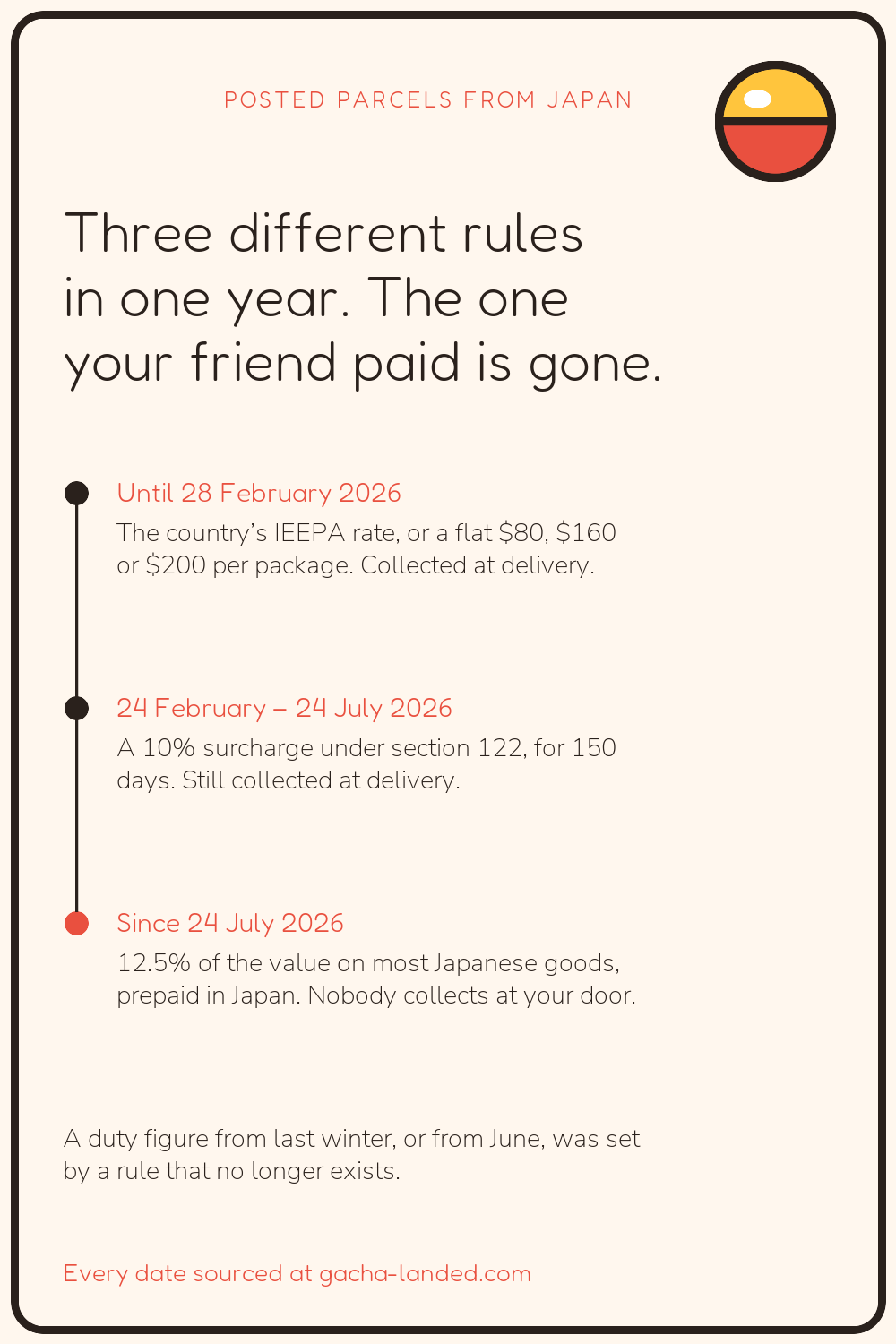
What this replaced: the 10% surcharge under section 122 of the Trade Act, which ran 150 days from 24 February 2026 and lapsed on 24 July, the same day the Section 301 action took effect. Before that, until the end of February 2026, the postal duty was the IEEPA rate for the country of origin, or a flat $80, $160 or $200 per package. A duty figure someone paid last winter was set by rules that no longer exist, and is not the number to budget from.
The gift exemption still exists, and it is not for this
The rules above suspend one exemption — the $800 administrative one. They leave alone the exemption for bona fide gifts of $100 or less sent by one person to another, and CBP's rule says so in as many words. Japan Post's table reflects it: a genuine gift under $100 still goes from any post office with nothing prepaid.
An item you bought through a proxy is not a gift, whoever is named on the label. Declaring it as one is a false declaration to customs, and the consequences fall on the person whose address it is sent to. Do not do it, and treat a proxy that offers to as a reason to use a different proxy.
One more requirement, since 8 July 2026
The Consumer Product Safety Commission now requires certificates of compliance for regulated consumer products to be filed electronically with the customs entry. Toys are a regulated category. CPSC's announcement stresses that it creates no new testing or certification duty — importers already had to hold this information — and that it applies regardless of shipment value, including low-value direct-to-consumer shipments. Foreign trade zone entries follow on 8 January 2027.
What the announcement does not say is whether an individual importing a single item for personal use is caught by it. We have not found an official answer, so this page does not give one.
What "DDP" on a Japan Post parcel means
DDP is "delivered duty paid": the duty has been paid before the parcel is handed to the carrier for delivery, so nothing is due from the person receiving it. On a Japan Post parcel to the US it is the mark Japan Post requires on the label once the sender has made the prepayment (see the table above); it is not a separate service you choose or a rate you are charged.
Older pages say Japan Post does not offer DDP to the US. That was true when posting was suspended; Ship&co, a shipping-software company, now describes a Japan Post DDP route to the US through Zonos, in a changelog entry dated 20 June 2026 that it labels beta. Treat that as a description of one seller's tooling, not as Japan Post's own terms, which are in the notices below.
Why other pages give you a different answer
Search results for this question on 13 October 2026 still included shipping-company and retailer pages written for earlier rules. Each of these was true for a while and none is the rule for a parcel posted now:
- "Parcels under $800 are duty-free"
- That was the de minimis exemption. It has been suspended for every country since 29 August 2025, and for postal shipments indefinitely since 24 July 2026.
- "A flat $80, $160 or $200 per package"
- The postal flat-rate option, which ended at the end of February 2026.
- "A 10% surcharge"
- The section 122 surcharge, which lapsed on 24 July 2026.
- "Duty is collected when the parcel is delivered"
- Removed by the CBP rule effective 24 July 2026. The prepayment is made in Japan.
If a page does not name the rule it relies on and the date it took effect, check it against the sources below before budgeting from it.
Two questions, answered directly
- Who pays duty on a package from Japan to the US?
- For a parcel of $2,500 or less sent through Japan Post, since 24 July 2026 it is the sender — prepaid before the parcel leaves Japan. For a proxy order, that sender is the proxy, and the charge reaches you as a line on their invoice, not a knock at your door.
- Do I pay duty again when the package arrives in the US?
- No. The rule that took effect 24 July 2026 removed on-delivery collection for postal parcels; the prepaid amount is reconciled between the filer and CBP afterward, in a monthly filing.
- How much is US duty on a package from Japan?
- Since 24 July 2026, 12.5% of the item value for anything whose normal rate is below 12.5% — which covers toys, figures, plush and stationery — and the normal rate alone for anything already at 12.5% or more. Books, recorded music and films are exempt. The operator's prepayment fee comes on top and is a quote, not a rate.
Once you have the prepayment figure, the comparison is arithmetic.
Sources
- CBP, Indefinite Suspension of the De Minimis Exemption for Mail Shipments and New Postal Informal Entry Process — interim final rule, published 24 June 2026, effective 24 July 2026
- Executive Order 14324, Suspending Duty-Free De Minimis Treatment for All Countries, 30 July 2025
- Japan Post, 米国宛て郵便物の引受再開に関するお知らせ(続報2), 14 July 2026 — the conditions table
- Japan Post, 米国宛て郵便物の引受再開について, 13 April 2026 — the prepayment operator and its fee
- Ship&co, Zonos integration: Ship to the US via Japan Post with DDP — changelog entry dated 20 June 2026, checked 20 October 2026; its page metadata shows a different date, which the page does not explain
- CBP, E-Commerce Frequently Asked Questions — the non-postal suspension and formal or informal entry; checked 27 October 2026
- CPSC, CPSC Implements Mandatory eFiling for Certificates of Compliance
- USTR, Notice of Actions in Section 301 Investigations, 91 FR 47318, published 28 July 2026, effective 24 July 2026 — "12.5 percent tariffs net of MFN on products of Japan", and the sum rule
- USTR, Fact sheet on the Section 301 action, July 2026 — the exemption for informational materials, donations and accompanied baggage
- USITC, Harmonized Tariff Schedule — column 1 general rates: 9503.00.00 Free, 4820.10.20 Free, 8523.49 Free, 4901.99 Free, 7117.19.15 8%, 7117.19.20 11%
- Supreme Court, Learning Resources, Inc. v. Trump, 20 February 2026 — the IEEPA tariffs
- Proclamation 11012, Imposing a Temporary Import Surcharge, 20 February 2026 — the section 122 surcharge and its 150-day term
Corrections
- 19 September 2026 — "So what rate is it?" used to say that what is charged on a Japanese-origin parcel today "is not something this page has verified against a document, so it does not say", and quoted CBP's 8.62% average from its rule analysis as the nearest published figure. The Section 301 notice of 28 July 2026 answers the question directly, so the section now states the 12.5% rule and its exemptions and the 8.62% average is gone.
- 9 September 2026 — an earlier version said the 8.62% figure excluded "IEEPA duties, which apply on top of it". Those duties had been struck down in February; the sentence now names what replaced them and says plainly that today's country-level rate is unverified here.