The end of US de minimis, in order
Last checked 6 October 2026. Every claim below links to the document it came from; where nothing official says it, this page says so instead.
Almost every guide to buying from Japan was written when a parcel under $800 arrived without duty. That stopped being true in August 2025, and the rules have changed three more times since. This is the sequence, with the document behind each step.
30 July 2025 — the order is signed
Executive Order 14324 suspends duty-free de minimis treatment for all countries. It also sets out two ways to charge postal shipments: a duty equal to the effective IEEPA tariff rate for the country of origin, or a flat amount per package — $80, $160 or $200 depending on that rate. The flat option is written to last six months and no longer.
27 August 2025 — Japan Post stops sending
Japan Post suspends acceptance of US-bound mail containing goods, and gifts worth more than $100, because there is no process yet for paying the duty the order requires.
29 August 2025 — the exemption ends
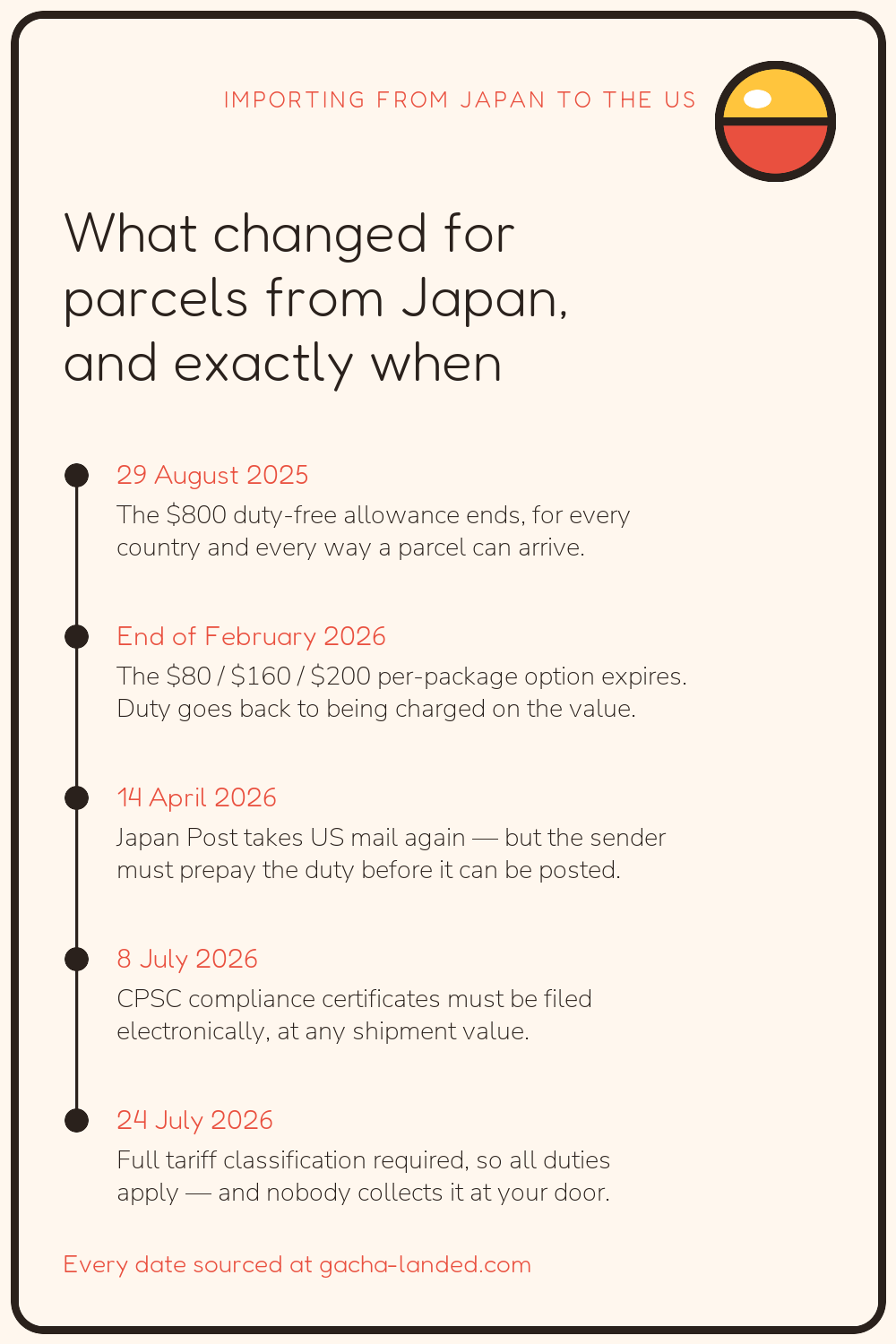
The order takes effect. Goods valued at $800 or less lose duty-free treatment regardless of country of origin, mode of transport or method of entry.
End of February 2026 — the flat option lapses
The six-month window in the order closes, and postal shipments must use the ad valorem method. The per-package option is worth remembering for scale: a $200-per-item duty on a ¥400 capsule toy would have been about fifty times the price of the toy. In practice CBP records that every qualified party chose the ad valorem method anyway.
20 February 2026 — the interim rate is set
Executive Order 14388 continues the suspension, and ties the postal duty rate to Proclamation 11012 of the same day, which imposed a 10% ad valorem surcharge under section 122 of the Trade Act of 1974 for a period of 150 days. For several months, that flat 10% was the whole of the duty on a low-value postal parcel.
14 April 2026 — Japan Post starts again
Acceptance resumes, on the condition that the sender prepays the US duty through an application run by a party CBP has approved, and marks the label DDP. Only designated post offices take these parcels.
8 July 2026 — CPSC eFiling becomes mandatory
Certificates of compliance for regulated consumer products, toys included, must be filed electronically with the customs entry, at any shipment value.
24 July 2026 — the rule replaces the order
CBP's interim final rule takes effect. The postal de minimis suspension becomes a regulation with no end date. A new postal informal entry replaces the interim process: a 10-digit HTSUS classification is now required, so all applicable duties are assessed rather than the flat 10%; the filing needs a filer code and a bond; and CBP stops preparing entry forms, so duty is no longer collected on delivery. Japan Post raises its prepayment ceiling from $800 to $2,500 to match.
The same morning, the 150-day section 122 surcharge lapses and a Section 301 action on 60 economies takes its place. For products of Japan it sets a duty of 12.5% net of the normal rate: an item whose normal rate is below 12.5% — toys, figures, plush, stationery — now comes out at 12.5% of its value, and one already at 12.5% or more pays only its normal rate. Books, recorded music and films are exempt. It is the first time since February that the rate on a Japanese parcel has been written in a document rather than argued about.
13 August 2026 — a court upholds the suspension
The Court of International Trade rules in Axle of Dearborn, Inc. v. Department of Commerce (Slip Op. 26-94) that the suspension stands. As reported, the court reasoned that suspending an exemption is not the same as imposing a new tariff, because Congress itself called de minimis a “privilege” that the President may withhold under IEEPA. Nothing in that ruling changes what a parcel from Japan pays; it removes one doubt about whether the suspension would survive. This page has not checked whether the decision is being appealed.
1 July 2027 — the exemption ends by statute, not by order
Every step above was an executive order, a proclamation or a CBP rule — each one something a future administration could undo on its own. Section 70531 of the One Big Beautiful Bill Act, signed 4 July 2025 as Public Law 119-21, repeals the same commercial de minimis privilege in the statute itself, for every country, with an effective date of 1 July 2027. From that date the end of duty-free entry under $800 is written into law rather than standing on a suspension that a later order could lift.
Why it matters for a ¥400 toy
Twice in a year, the arithmetic of importing a cheap item changed in a direction that favours buying it from a US store — first because duty started applying at all, then because the flat 10% gave way to whatever the classification says, with a filing and a bond behind it. Neither change touches what a US importer charges you, because duty on that route was already paid by the importer and priced in.
Sources
- Executive Order 14324, 30 July 2025 — the suspension, the two methodologies, and the six-month limit on the flat option
- Notice of Implementation of Executive Order 14324, 2 September 2025
- CBP, Indefinite Suspension of the De Minimis Exemption for Mail Shipments, effective 24 July 2026 — also the source for E.O. 14388, Proclamation 11012 and the choices qualified parties made
- Japan Post, 13 April 2026 and 14 July 2026 notices
- CPSC, mandatory eFiling
- USTR, Notice of Actions in Section 301 Investigations, 91 FR 47318, effective 24 July 2026 — the 12.5% net-of-MFN duty on products of Japan; the exemption for informational materials is in USTR's fact sheet
- Congress, Public Law 119-21, the One Big Beautiful Bill Act, signed 4 July 2025 — §70531 repeals the commercial de minimis privilege by statute, effective 1 July 2027
- Court of International Trade, Slip Op. 26-94, 13 August 2026 (opinion not read in full by this page; the holding is as summarised by TaxProf Blog, 15 August 2026; checked 6 October 2026)