Proxy from Japan, or a US importer?
Last checked 19 September 2026. Every claim below links to the document it came from; where nothing official says it, this page says so instead.
The question is narrower than it looks
For one small item — a capsule toy, a figure, a plush — the honest answer is usually the US importer, and the reason is not markup. It is that the import route carries costs the store route does not — an international parcel, a proxy's fee, and duty that is now charged at any value — while the US store has already paid all of that across a whole carton and divided it by a few hundred items.
Importing wins when you can spread those same fixed costs: several items in one parcel, something no US store lists, or a price gap wide enough to survive the shipping quote.
What you need before you can answer it
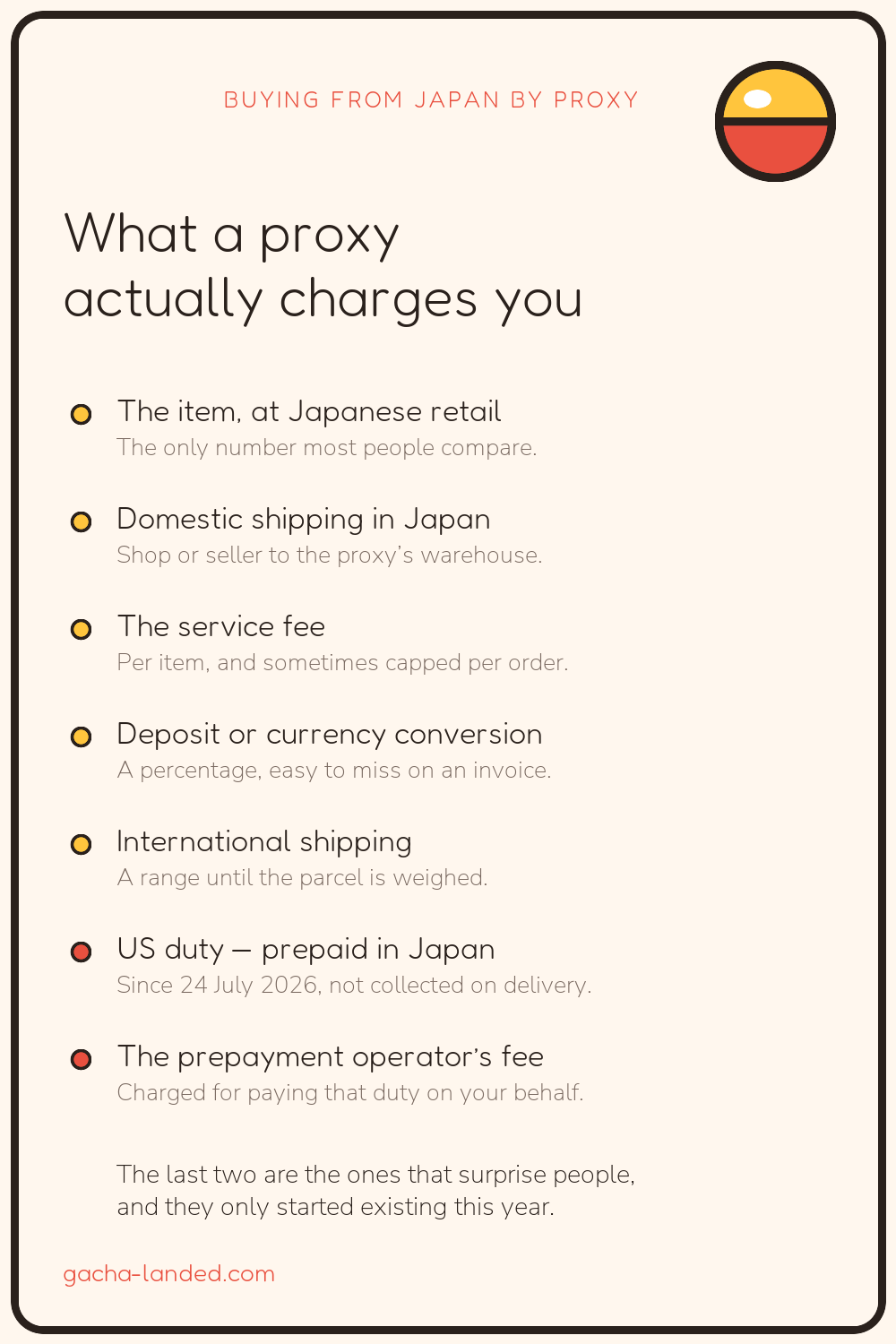
Six numbers, and no substitutes for the ones you do not have:
- The Japanese retail price, and whether the item is actually listed somewhere a proxy can buy it. A price on the side of a machine is not a price anyone can order at.
- The US listing price, and its shipping — free, a flat rate, or unknown.
- The proxy's service fee, per item and any per-order cap.
- Domestic shipping inside Japan to the proxy's warehouse.
- International shipping, which is a range until the parcel is weighed.
- Duty and the customs prepayment fee, which for a postal parcel is now paid in Japan before it ships. How that works, and who pays it — and since 24 July 2026 the duty itself is a published rate, 12.5% on most goods of Japan (item by item); only the fee is still a quote.
Two more that are easy to forget: US state sales tax on the store purchase, and the proxy's deposit or currency-conversion charge. Both are real, and neither is in most comparisons.
Three rules this site follows, and you should too
Every total is a range. International shipping is not final until the parcel is weighed, and duty depends on classification and declared value. A single number implies a precision that does not exist, and it is always the import route that gets flattered by it.
Leaving duty out can only prove one thing. Duty is charged on the import route and not on the US store. So a comparison without duty can still show that the store is cheaper — adding duty would only widen that gap. It can never show that importing is cheaper, because the missing cost belongs to the route that appears to win.
A blank is unknown, not zero. If you do not have the proxy's shipping quote, the answer is that you do not know yet, not that shipping is free.
When importing is actually worth it
Ask what the parcel would carry rather than what the item costs. The proxy fee, the domestic leg and the international leg are mostly per-parcel, so they divide. Ten items through one proxy order is a different question from one item, and it is the only version of the question where the answer flips reliably.
The other case is availability. If no US importer lists it, there is nothing to compare and the only question left is whether the landed cost is worth it to you.
Put your own numbers in and see both routes on one axis, with the overlap where neither wins marked as exactly that.